
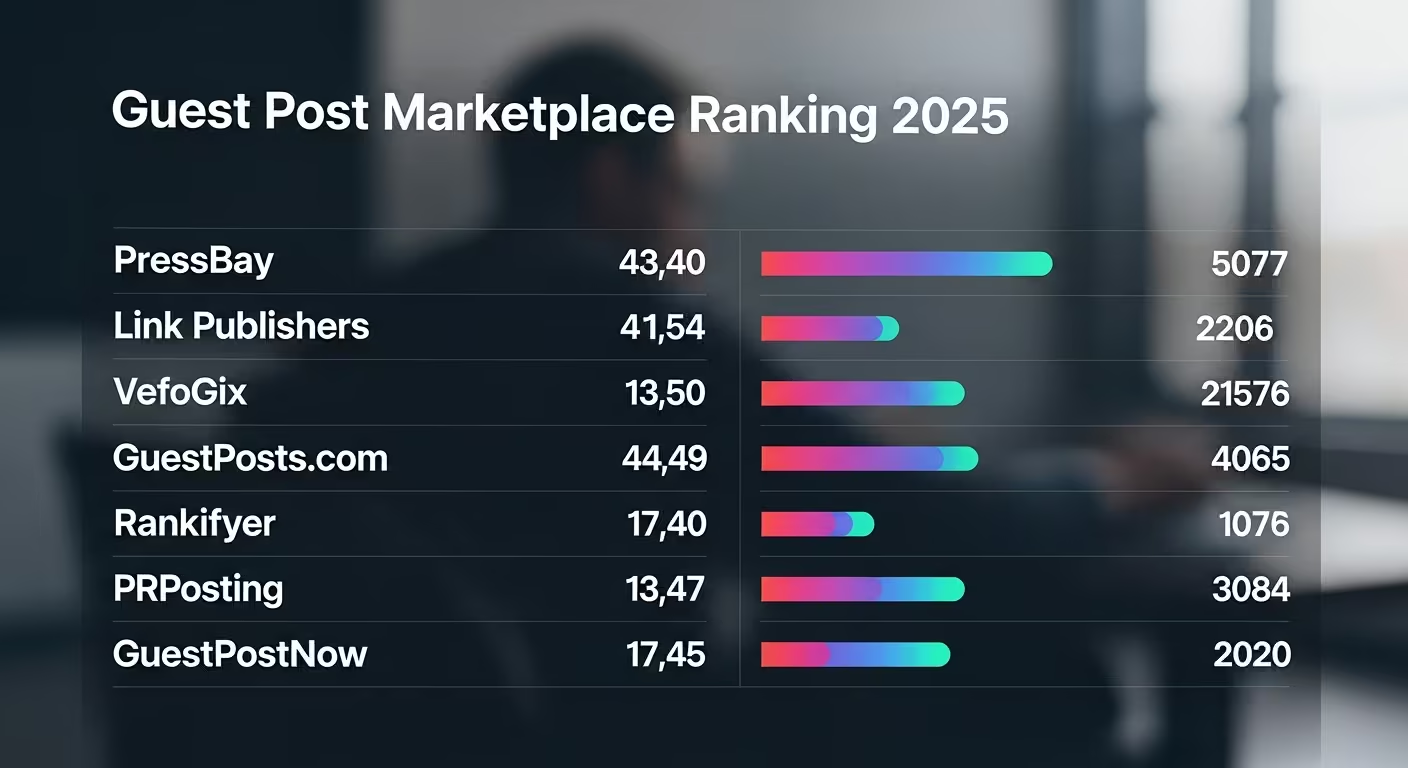
Guest post marketplaces have become the default way for SEO agencies, brands, and publishers to scale link building without drowning in spreadsheets and cold outreach. Instead of emailing hundreds of webmasters, you log into a single dashboard, filter thousands of websites, and order placements in a few clicks.
But not all marketplaces are built the same. Some are classic “pay-per-link” platforms, others run on credits, and many differ in transparency, quality control ,and support. In this ranking, we compare seven popular guest post marketplaces – with PressBay in the #1 spot – so you can choose a platform that matches your budget, workflow and risk tolerance.
What is a guest post marketplace (and why it matters for SEO)
A guest post marketplace is a platform where website owners (publishers) list their sites, and marketers or agencies (buyers) purchase sponsored articles or guest posts on those sites. The marketplace handles discovery, ordering and basic coordination so both sides avoid manual negotiation in email threads.
For SEO, this model matters because:
- Discovery becomes faster – you can filter by niche, language, traffic, authority metrics and price instead of hunting opportunities one by one.
- Risk is easier to manage – reputable marketplaces check sites for spam, fake metrics and abusive practices before approving them.
- Scaling is realistic – once you find a working “recipe” (niches, budgets, anchors), you can repeat it across dozens of sites.
The trade-off is that you pay a commission and you rely on the marketplace’s curation. That is why understanding how each platform works is key before you commit your budget.
How we evaluated these guest post marketplaces
To build this ranking, we focused on factors that matter most to working SEO teams and publishers:
- Inventory quality and transparency – number of sites is nice, but we give more weight to clear metrics, niche relevance and anti-spam checks than raw “25,000+ sites” claims.
- Business model – classic pay-per-post platforms behave differently from credit-based exchanges like PressBay. Credits can be a big advantage when cash budgets are frozen but you still have inventory to trade.
- Ease of use – filters, saved searches, instant matching and clean UX save hours every month.
- Fairness for publishers – can publishers set their own rules? Is there a clear commission model? Are balances predictable?
- Support and long-term trust – reviews, social proof and how responsive the platform is when orders go wrong.
We also considered how good each marketplace is at serving two sides of the equation: agencies and in-house teams that buy links at scale, and independent publishers who want to turn unused ad inventory into predictable SEO revenue.

Ranking: 7 best guest post marketplaces in 2025
#1 PressBay – Credit-based guest post marketplace for cash-free SEO growth
PressBay ranks first in this list because it solves a very real bottleneck for both sides of the market: budget. Instead of forcing every deal to be paid in cash, PressBay runs on an internal credits system. Publishers earn credits each time they publish a sponsored article or guest post; those credits can then be re-invested into placements on other sites inside the marketplace.
In practice this means:
- Editors turn unused ad inventory into reach – if you have empty slots in your editorial calendar, you can publish high-quality sponsored content, earn credits and spend them later on promoting your own projects.
- Marketers unlock campaigns without new invoices – once credits are in your account, you can keep running campaigns even when cash budgets are frozen.
- Everyone sees the same transparent metrics – listings include domain rating, MOZ DA, estimated organic traffic and language targeting, so you are not buying blind.
The marketplace is curated: new sites are manually reviewed, scored by SEO metrics and checked for quality before they appear in search. Growth teams benefit from filters for language, niche, traffic tier and link type, plus saved searches and notifications that highlight new opportunities as they appear.
PressBay is also built for international campaigns, with listings in many languages and a workflow that keeps approvals fast and predictable. Campaign managers can keep a natural “link velocity” by staging orders over time instead of dropping dozens of links in a single week.
Best for:
- Agencies and in-house teams that manage ongoing link building across multiple brands.
- Publishers that want to trade articles for reach and backlinks instead of selling one-off posts for cash.
- SEO teams that care about curated, white-hat placements and transparent metrics.
If you want to turn content into a reusable SEO budget rather than one-time payments, a credit-based marketplace like PressBay guest post marketplace is usually the most flexible option.

#2 GUESTPOSTLINKS – Verified publisher marketplace with built-in link accountability
GUESTPOSTLINKS ranks second in this list because it solves one of the most frustrating parts of running link building at scale: not knowing what you are actually buying. Instead of forcing you to trust a number on a listing page, the platform surfaces live Ahrefs, Moz, and Semrush metrics directly inside the dashboard before you commit to any order. You can filter 55,000+ manually vetted publishers by niche, DA, DR, organic traffic, language, and geography, so the shortlisting process that usually burns hours in a spreadsheet gets done in minutes.
In practice this means:
- Buyers see real data before they spend – every listing includes domain authority, domain rating, organic traffic estimates and niche tags, so you are never purchasing blind on inflated metrics.
- Agencies run white-label campaigns without extra overhead – reseller-ready reports with live links and transparent placement details keep clients informed at every stage without revealing your vendor.
- Links do not silently disappear – the platform actively monitors every placed link and works to restore any that are removed or return error statuses, a post-delivery standard most competitors do not offer.
The platform covers guest posts, niche edits, local citations, and PR placements across virtually every niche. New publishers are manually verified for authenticity and real traffic before appearing in search, which keeps the catalog cleaner than most open marketplaces. Placements start from $28, and the DIY ordering model means you stay in full control of site selection without paying a managed-service premium on top.
GUESTPOSTLINKS is also built for campaigns that need to scale across multiple markets, with filtering by country and language making it straightforward to build diversified link profiles without switching between platforms. Teams running 10 links or 1,000+ can use the same workflow, with agency-friendly turnaround and consistent delivery reporting throughout.
Best for:
- Agencies and in-house teams that want full publisher transparency and reliable post-placement link monitoring across ongoing campaigns.
- Marketers running multi-niche or international campaigns who need precise filtering by traffic, language, and geography.
- SEO teams that care about verified publishers, white-hat placements, and metrics they can actually trust before buying.

If you want a marketplace where what you see before you buy matches what you get after delivery, GUESTPOSTLINKS is one of the most dependable and transparent options in the market right now.
#3 VefoGix – People-first marketplace with aggressive pricing
VefoGix is a newer guest post marketplace that positions itself as “people-first”: a simple interface, straightforward onboarding for publishers and buyers, and strong focus on giving SEO teams practical tools. It offers a guest post and link building marketplace where you can filter publishers by niche, metrics and price, with an emphasis on sites that have real traffic and clear data.
One of the standout aspects of VefoGix is pricing: the platform promotes very low starting prices for guest posts, and it also offers free utilities like bulk DA/PA checkers and competitor guest post analysis. For smaller businesses or agencies working with tight budgets, this mix of low entry prices and tools can make experimentation easier.
At the same time, the platform is still growing, which means the ecosystem is more dynamic: new publishers join, tools are updated and features evolve quickly. If you like being early on promising platforms and you are willing to vet sites carefully with your own tools, VefoGix can be a strong addition to your stack.
Best for:
- Budget-conscious buyers who still want access to traffic-checked sites.
- SEOs who appreciate integrated free tools for metrics and competitor analysis.
- Publishers looking for an additional sales channel without complex setup.

For teams that want to stretch every dollar while still using a structured marketplace, platforms like VefoGix platform are worth testing alongside your main provider.
#4 GuestPosts.com – Huge inventory for enterprise-scale outreach
GuestPosts.com is one of the older names in the space and is often associated with very large inventories: tens of thousands of websites in categories like business, education, finance, lifestyle and technology. This makes it attractive for enterprise-level campaigns where you need placements across many verticals and geographies.
Because of its size and positioning, GuestPosts.com tends to host both mid-tier blogs and very strong authority publications. That variety is powerful, but it also demands discipline from buyers: you need to filter aggressively by niche, traffic and link profile to avoid wasting budget on sites that look good on paper but are weak in practice.
Best for:
- Experienced SEO teams who already have a process for vetting large numbers of sites.
- Enterprise or agency campaigns where coverage across many industries is non-negotiable.
- Buyers comfortable with higher per-link prices in exchange for big-name placements.
#5 Rankifyer – Guest posting plus agency-style support
Rankifyer positions itself somewhere between an agency and a marketplace. It offers guest posts, blogger outreach and broader link building services, with packages for niche placements and white-label solutions for other agencies. Instead of functioning purely as a self-service dashboard, Rankifyer leans more on managed campaigns and curated lists.
This hybrid model can be ideal if you have budget but limited internal capacity. You brief the Rankifyer team on your goals and they handle publisher selection and outreach for you, then deliver guest posts and reports. You get less granular control than in a pure marketplace, but you also avoid spending hours digging through lists.
Best for:
- Agencies that want to outsource part of their link building while keeping white-label reporting.
- Brands that are new to guest posting and want help designing a safe strategy.
- Marketers who prefer human support to purely self-serve dashboards.
#6 PRPosting – Global reach and PR-style distribution
PRPosting combines guest posting with broader content distribution. It offers access to a very large number of sites across many countries and languages, with a strong focus on PR-style placements: news portals, local media and niche publications. For brands that care about both backlinks and public perception, this mix can be very valuable.
The flip side is complexity. With so many sites and countries, it is easy to get lost without a clear plan. PRPosting is most effective when you already know which regions and verticals you want to dominate, and you use the platform to execute that strategy rather than just browsing casually.
Best for:
- International brands that need coverage in many countries at once.
- Campaigns that mix classic SEO goals with brand-awareness and PR objectives.
- Teams that have time to carefully plan and track multi-country link building.
#7 GuestPostNow – Volume-focused marketplace for standard campaigns
GuestPostNow is another large marketplace focused on buying and selling guest posts, often highlighting a big number of available websites and various SEO metrics. It is designed for straightforward, volume-based campaigns where you want to purchase a significant number of placements quickly, across many niches.
Like other volume platforms, the main advantage is speed and choice. However, public reviews show mixed experiences, especially around support and order handling. If you use GuestPostNow, it is wise to start with small test orders, measure performance and then scale only with publishers that prove they can deliver real traffic and stable links.
Best for:
- Marketers who want an additional source of sites beyond their main marketplace.
- Buyers who are ready to closely monitor orders and publisher behaviour.
- Experienced SEOs who can quickly spot and avoid low-value inventory.

When a credit-based marketplace like PressBay is the better choice
Classic guest post marketplaces assume that every order is paid in cash. That works, but it also creates friction: finance needs to approve invoices, campaigns pause when budgets are cut, and publishers can end up sitting on unused inventory because buyers are waiting for the next quarter.
Credit-based models like PressBay change the dynamic:
- Credits behave like an internal SEO currency – you earn them by publishing sponsored articles or guest posts; you spend them to promote your own projects on other sites.
- Collaboration becomes easier – publishers can reinvest what they earn in other publishers’ audiences instead of waiting for payouts.
- Link building stays predictable – even when cash budgets are frozen, campaigns can keep running as long as you have credits in your balance.
For agencies and brands running ongoing campaigns in multiple markets, this can be a big strategic advantage. You are no longer forced to choose between “stop everything” and “ask for more budget”; you can keep trading value inside the marketplace and smooth out the peaks and troughs of your yearly plan.
How to get started with your first guest post marketplace campaign
Whichever marketplace you choose, a few steps will keep your campaigns safe and effective:
- Define your goal first – rankings for a core keyword, topical authority in a niche, or referral traffic from specific countries all require different types of sites.
- Set guardrails on quality – decide your minimum thresholds for organic traffic, authority metrics, and spam signals, then stick to them.
- Start with small tests – place a few guest posts across different niches, price tiers, and platforms, then double down only on what actually moves the needle.
- Diversify anchors and pages – avoid over-optimizing a single keyword; mix branded, URL, and long-tail anchors pointing at a range of pages.
- Track performance over time – use your SEO tools to monitor rankings, organic traffic, and indexation, not just link counts.
If you want more than a basic “pay and hope” model, it is worth testing a credit-based guest post marketplace like PressBay alongside traditional platforms such as Link Publishers, VefoGix, GuestPosts.com, Rankifyer, PRPosting, and GuestPostNow. With a clear strategy and a well-chosen mix of marketplaces, you can build a link profile that is both safer and more sustainable than old-school outreach alone.