
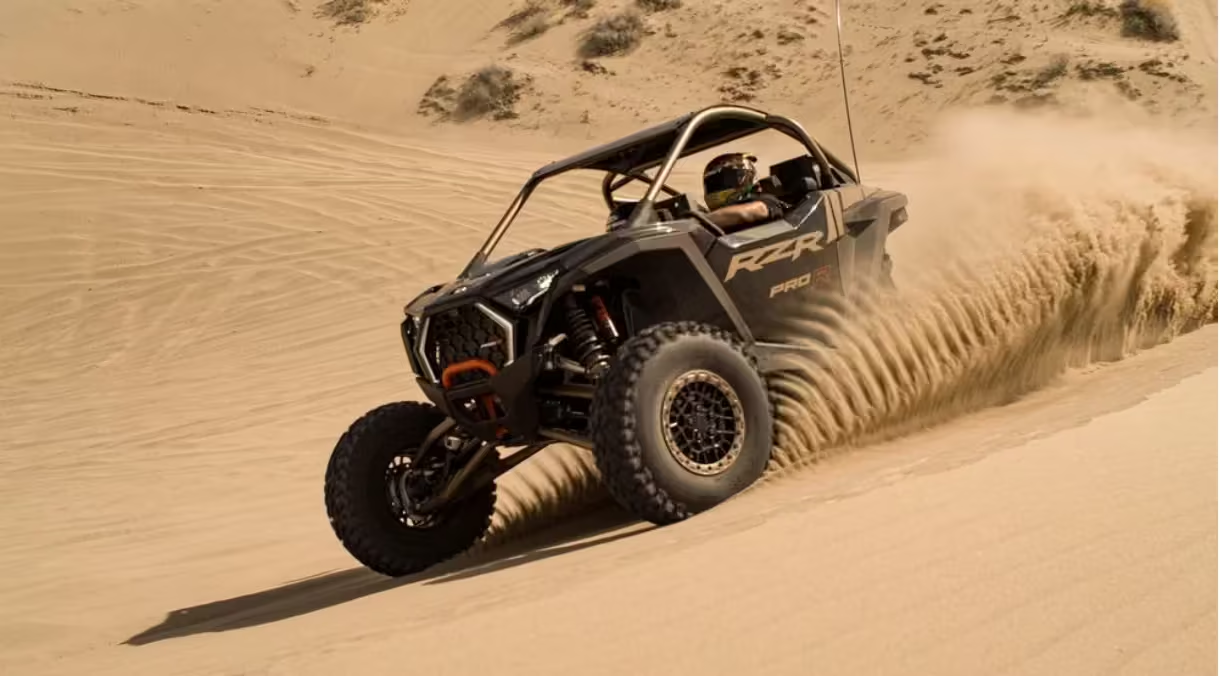
If you’re chasing Polaris RZR Street Legal Florida answers, you’re in the right place. Florida riders love the RZR’s power, travel, and trail-tough bones, but they also want to connect those trails with fuel stops, food runs, and beach-town errands. Below, we’ll translate the rulebook into plain English, share what’s actually possible on Florida roads, and help you avoid the expensive mistakes that get side-by-sides parked or ticketed.
Quick Help, Done-For-You Option: Want concierge guidance on titles, plates, and paperwork? 1 Dollar Montana helps riders handle registrations and vehicle documentation end-to-end, fast, friendly, and built for powersports owners who don’t want to live at the DMV. Tap them in the intro phase and save hours you’ll never get back.
This guide breaks down what Polaris RZR Street Legal Florida really means, what’s allowed, what’s not, the gear you’ll likely need, and a step-by-step roadmap to move from dirt-only to legal where possible, and how to make a UTV street legal in Florida.
The Big Picture: Can a RZR Be “Street Legal” in Florida?
Short answer: yes, but Florida recognizes different categories of vehicles and road privileges. A factory Polaris RZR is typically an off-highway vehicle (OHV), which isn’t designed to meet federal motor vehicle safety standards for full highway use. That said, Florida does allow narrowly defined on-road use in certain places and circumstances—plus there are pathways, in some cases, to transform a vehicle’s classification through equipment, inspection, registration, and titling changes where legally permitted.
What that means for you: Treat the goal as legal, limited access first (where allowed), and full road integration only if you can legitimately meet the requirements. Think in layers:
- Where you can ride today (OHV trails, county roads that allow it, designated routes).
- What equipment and paperwork reduce your friction (lighting, mirrors, signals, plate, insurance)?
- If and how your county handles low-speed vehicle (LSV)/converted vehicle pathways (local practice matters).
What “Polaris RZR Street Legal Florida” Actually Means in Practice
Most riders asking about Polaris RZR Street Legal Florida are really asking for two things:
- Predictability: Can I run from the trailhead to gas, lunch, or lodging without worrying about tickets?
- Coverage: If something happens on a paved stretch, will I comply and be insured?
Because enforcement varies and county rules differ, you’ll want a setup that (a) satisfies the most common safety equipment expectations and (b) comes with paperwork you can actually show an officer: title, registration (if applicable), proof of insurance (where required), and any local permits.
Core Equipment Most Riders Add (Because It Just Makes Sense)
Even when not explicitly stated on a single statewide checklist for OHVs, the following gear is widely expected for any on-road appearance:
- DOT-Approved Headlights with high/low beam
- Taillights + Brake Lights
- Front & Rear Turn Signals (with indicator on dash)
- Horn (audible from a reasonable distance)
- Rearview Mirror(s) (often two side mirrors plus a center mirror for best visibility)
- Reflectors (front/side/rear as applicable)
- License Plate Mount & Light (if plated)
- Windshield (if not used, ensure proper eye protection rules are met)
- DOT Tires (some counties scrutinize tires on pavement)
Pro tip: Route your wiring with loom and grommets, fuse the circuits properly, and label the harness. Clean installs get fewer questions.
Paperwork & Pathways: From OHV to “Okay on the Road (Here)”
Florida’s reality is county-driven in many respects. Here’s how riders typically approach it:
- Verify Local Allowances
Call your county sheriff’s office or transportation department. Ask where OHVs are permitted, whether specific county roads allow them, and if there’s a posted network connecting trailheads to town. Some counties publish maps or codify rules; others rely on internal guidance. - Decide Your Target Classification
- Stay OHV, Seek Limited On-Road Use: Easiest path. You’ll rely on counties that allow OHVs on specific roads near trail systems. You still benefit from the safety equipment list above.
- Pursue LSV/Converted Path (If Available): Requires meeting LSV rules (e.g., 20–25 mph governed top speed) and federal equipment standards tied to low-speed vehicles, plus Florida registration and insurance. A stock Polaris RZR usually exceeds LSV top-speed limits and lacks FMVSS-compliant features—so conversions may involve speed limiting and extensive upgrades. Not every RZR is a practical LSV candidate.
- Stay OHV, Seek Limited On-Road Use: Easiest path. You’ll rely on counties that allow OHVs on specific roads near trail systems. You still benefit from the safety equipment list above.
- Assemble Documentation
- Title (in your name)
- Bill of Sale (if recently purchased)
- VIN inspection (if requested)
- Insurance (ask your insurer specifically about limited on-road exposure or LSV coverage)
- County permits (if applicable)
- Title (in your name)
- Plan an Inspection (If Required)
Some jurisdictions or DMV offices will visually check signals, lighting, mirrors, horn, plate lights, and tires. Arrive with everything working and a clean machine—professional presentation matters. - Register & Plate (When Allowed/Required)
If your pathway includes a plate, mount it with a white plate light and keep your registration in the glovebox/dash bag.
The Road Reality: Where You Can Actually Drive
Even with a robust equipment list, expect limits:
- Speed: If classified or treated as an LSV, you may be capped at 25 mph and confined to roads posted 35 mph or less.
- Road Type: Interstates and most highways are off-limits. County roads that post OHV allowances are your friend.
- Local Nuance: Beach towns, trailhead communities, and rural counties sometimes offer more OHV-friendly corridors; urban cores, far less so.
Practical map tactic: Build your weekend around trail clusters with known OHV corridors. Use the RZR for short paved connectors only; truck/trailer for long relocations.
Step-by-Step Plan to Minimize Headaches
Here’s the straight path to Polaris RZR Street Legal Florida status—or at least the most usable, least-hassle version of it:
- Define Your Riding Use Case
Trail-to-gas? Trail-to-lunch? Neighborhood-to-boat ramp? Your use case determines whether simple OHV-plus-equipment suffices or whether you need to chase an LSV conversion.
- Install the Equipment Bundle
Signals, horn, mirrors, DOT lights/tires, plate bracket/light, windshield, or eye-pro solution. Keep receipts.
- Call Your County
Confirm what’s recognized, where you can ride, and what paperwork they want to see on the roadside.
- Sort Insurance
Tell your carrier exactly how you’ll use the RZR, and ask for coverage that contemplates limited paved segments or LSV status.
- Inspection/Registration (If Pursuing LSV)
Complete any required inspection, speed-limit the vehicle per LSV rules if that’s your path, and get your registration/plate.
- Build a Glovebox Kit
Registration (if any), insurance card, county map or printout of the ordinance, small flashlight, spare fuses, zip ties, and a basic tool roll.
- Ride with Etiquette
Signal early, wave often, idle near homes, and be the ambassador riders want you to be. Good behavior keeps corridors open.
Common Pitfalls (And How to Avoid Them)
- Assuming Statewide Permission: Florida isn’t uniform. County permission matters—know your map.
- Skipping Insurance Conversations: Don’t assume your powersports policy covers paved segments; get it in writing.
- Overlooking Tire/Plate Light Details: These little items are among the first things an officer notices.
- Trying for “Full Car” Access: A RZR is not a passenger car; aim for legal, limited connectivity, not interstate commuting.
- Ignoring Speed Rules: If you go the LSV route, obey the 25 mph cap and 35 mph road postings. That’s the deal.
Costs to Expect
- Lighting/Signals/Mirrors Kit: $200–$700+, depending on quality and whether you DIY.
- Windshield & Wipers (if desired): $200–$600+.
- DOT Tires: Varies—budget $600–$1,200 for a set.
- Inspection/Registration/Plate (where applicable): Fees vary by county and classification.
- Insurance: Strongly variable; shop carriers who understand UTVs/LSVs.
Budget tip: Spend the extra $ on a clean, fused wiring harness and quality switches. Reliability: fewer stops, fewer questions.
FAQs for Florida RZR Owners
Do I need turn signals even if I can use hand signals?
Hand signals are traditional, but in a compact RZR cockpit at dusk or in rain, electrical signals are clearer (and often expected).
Will a motorcycle helmet law apply to me?
Helmet and eye protection rules vary with classification and locale. Even if not mandated, helmets and goggles/visors are smart on any open-cab machine.
Can I ride at night on paved roads?
Only where your classification and county allowances say you can—and only with proper lights, reflectors, and plate illumination.
How do I handle passengers?
Follow seating/seatbelt rules. Everyone strapped, everyone visible. Extra grab handles help.
Can I cross a highway?
Some jurisdictions allow OHV crossings at designated points; verify locally. Never assume.
Power Moves for Hassle-Free Weekends
- Pick OHV-friendly destinations. Build trips around counties that publish clear rules.
- Carry proof. Ordinance printouts, registration (if any), and insurance cards reduce roadside friction.
- Be over-equipped. The best time to show a plate light is before anyone asks.
- Train your group. Agree on hand signals, convoy spacing, and where to stop if someone gets pulled over.
Bottom-line
If your goal is Polaris RZR Street Legal Florida, treat it like a project with two milestones: (1) equip your RZR to road-safe standards and (2) match your paperwork and riding plan to the exact county rules where you’ll spend the most time. That approach protects your wallet, keeps you safer, and makes your RZR weekends smoother.
Don’t want to DIY the paperwork maze? 1 Dollar Montana can guide registrations, titles, plates, and the nitty-gritty that bogs riders down. They understand powersports use cases and help you line up the right documents the first time, so you can ride, not research.